On Saturday, November 28, the sun sets over Pensacola at 4:47 p.m. A few minutes later, volunteers from the Escambia Amateur Astronomers Association start setting up telescopes in the East Beach parking area at the far end of the Big Lagoon State Park drive. The state's event listing says the session runs from 5 to 11 p.m. By the time 5 p.m. comes around, the front gate on Gulf Beach Highway has already been locked for more than ten minutes.
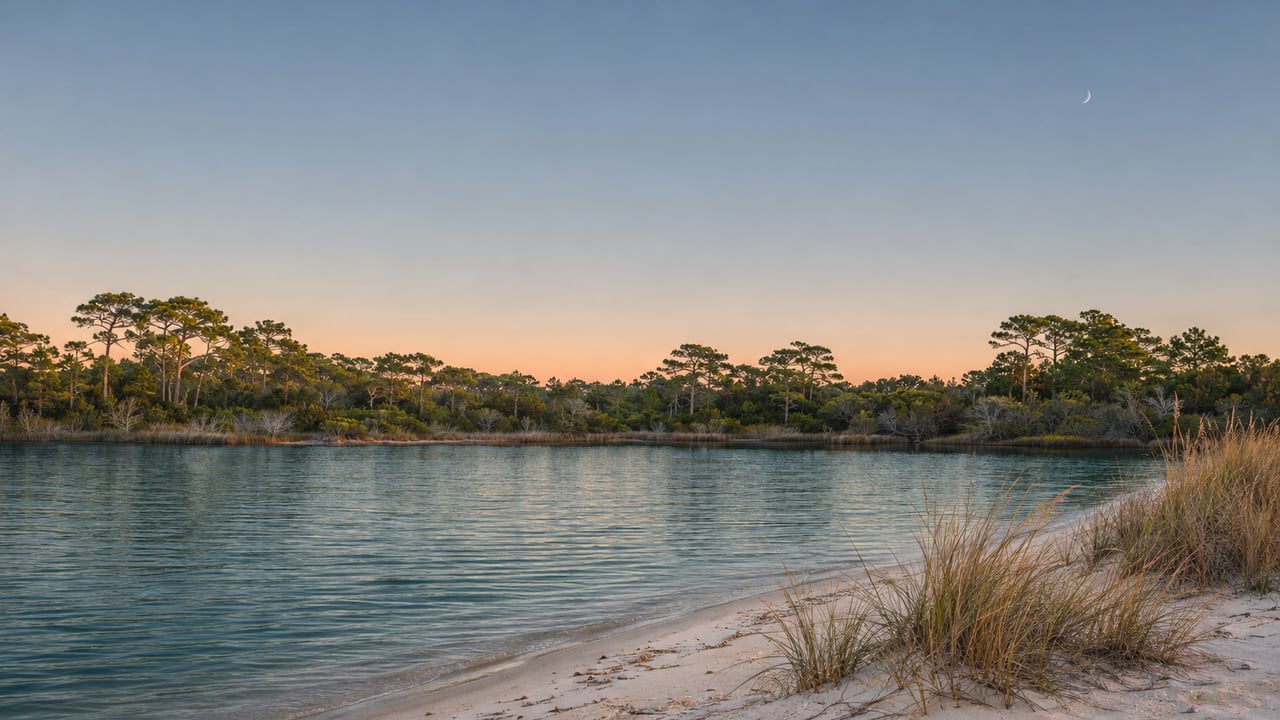
That gap defines how a winter star party at Big Lagoon works. The listed start time matters less than the gate. The evening starts in the last daylight, and because the park sits right on Big Lagoon, that daylight hour has its own wildlife to watch.
The gate decides when the evening begins
The Florida State Parks event page for "An Evening Under The Stars" spells out the rule plainly:
"All participants MUST have entered the park prior to closing time; which is sunset, this time varies throughout the year. The front gates will be locked at that time, and visitors will NOT be permitted to enter the park after closing time."
Big Lagoon's regular hours are 8 a.m. to sunset, every day of the year. In summer, sunset comes well after 5 p.m., so the posted start time and the gate don't conflict. After Daylight Saving Time ended on November 1, they started to. According to timeanddate's Pensacola sun table, sunset falls at 4:48 p.m. from November 24 to 27, at 4:47 p.m. on November 28 and through the first week of December, and moves back to 4:49 p.m. by December 12. On the two 2026 dates still ahead, the lock time comes before the listed start.
Because sunset changes through the season, the park asks visitors to call the Ranger Station at 850-492-1595 to find out when the gate locks that night. The stargazing is free, but the regular entry fee still applies: $6 per vehicle for two to eight people, $4 for a car with one person, and $2 for anyone arriving on foot or by bicycle.
What the last hour of light offers at East Beach
Arriving before the lock time means you'll be in the park while there's still light, and the telescope site has things to see in daylight too. Big Lagoon covers 704 upland acres between the mainland and Perdido Key. Its three-story observation tower looks out over the water, and the ranger station lends binoculars to visitors.
According to the Great Florida Birding and Wildlife Trail's Big Lagoon profile, the views from the East Beach tower in winter include Lesser Scaup, Redhead, Bufflehead and Red-breasted Merganser on the water, with Black-bellied Plovers, Dunlin and Least Sandpipers along the shore. These are winter visitors, so the tower is at its best for ducks in exactly the months the star parties run.
A winter session on a clear Saturday tends to run in this order:
- Call the Ranger Station that morning and get the gate time.
- Drive in through the front gate on Gulf Beach Highway before sunset and pay at entry.
- Borrow binoculars at the ranger station if you didn't bring a pair.
- Go to the end of the park drive and climb the tower while there's still enough light to make out the ducks on the lagoon.
- Walk down to the East Beach parking area, where the telescopes are set up.
- Look for Saturn as twilight fades.
The last step comes from Sky & Telescope's observing guide for November 6–15, which describes Saturn as the first point of light to appear as twilight fades, high in the east-southeast, and crossing the meridian around 9 to 10 p.m. in mid-November. The same guide says Mars and Jupiter rise in the east-northeast around 11 p.m. or midnight, which is about when the session wraps up.
Picking a night by the moon
With the gate rule handled, the next thing to plan around is the moon. The association sets out telescopes and binoculars for the moon, planets and other objects, as long as the sky is clear. A bright moon is worth looking at through a telescope, but it also washes out fainter objects. The event page lists every date in the series. The table below pairs the dates through February with the moon illumination figures from timeanddate's Pensacola moon tables, which are calculated at lunar noon.
| Session date | Moon illumination | What else is happening |
|---|---|---|
| Sat., Nov. 28, 2026 | 80.4% | Thanksgiving weekend, with a mostly lit moon |
| Sat., Dec. 12, 2026 | 12.6% | Geminid meteor shower active, a day before its peak |
| Sat., Jan. 2, 2027 | 23.5% | First session of the new year |
| Sat., Jan. 16, 2027 | 62.6% | Moon more than half lit |
| Sat., Jan. 30, 2027 | 39.7% | Moon less than half lit |
| Sat., Feb. 13, 2027 | 46.2% | Two days after Jupiter's opposition |
| Sat., Feb. 27, 2027 | 57.5% | Eight days after Mars's opposition |
The series continues after February, with sessions on March 13, March 27 and April 10.
December 12 is the darkest night of the season
Two things line up on Saturday, December 12. First, the moon is only 12.6% illuminated, the lowest of any date in the table. Second, the session falls inside the Geminid meteor shower. NASA's Geminids page lists the shower as active from December 4 to 17 in 2026, with a forecast peak on the night of December 13–14 and rates of 40 to 50 meteors per hour under dark skies. NASA also says the shower usually picks up around 9 or 10 p.m., so you'd see the start of it during the last part of a session that runs until 11.
On that date sunset is at 4:49 p.m., so the gate rule still applies. With a dark sky and the meteor shower building, this is the session where getting in before the gate locks pays off most.
The February sessions are timed well for planets. According to EarthSky, Jupiter reaches opposition on February 11, 2027, when it rises in the east as the sun sets. EarthSky puts Mars's opposition on February 19, 2027, in the constellation Leo. The February 13 session comes two days after Jupiter's opposition, and February 27 comes eight days after Mars's.
Why Big Lagoon is the place to be on the Key after dark this winter
The other public shorelines on and around the Key close early in winter. At Gulf Islands National Seashore's Perdido Key Area, which includes Johnson Beach, hours from November 1 through February 28 are 5 a.m. to 6 p.m., compared with 8 p.m. the rest of the year. Overnight parking is prohibited year-round. The National Park Service announced on October 26 that all seashore areas, including Johnson Beach, had reopened after the Hurricane Isaias closures. It asked visitors to take care on trails and to respect any signed closures. The east restrooms at Rosamond Johnson Beach are being renovated, and the west restrooms remain open until that work is finished.
Perdido Key State Park is open from 8 a.m. to sunset, the same as Big Lagoon, and costs $3 per vehicle. In winter, Florida State Parks lists black skimmers, loons, gannets and mergansers among the birds there. The Florida Birding Trail's Johnson Beach profile records Northern Gannets from October through March.
Those hours shape the whole season. At Johnson Beach, the evening ends about an hour after sunset, and at Perdido Key State Park it ends at sunset. Big Lagoon also closes at sunset, but a scheduled session lets you stay in the park until 11 p.m. once you're inside. On these Saturdays it's the one public shoreline nearby where you can stay after dark with telescopes set up for anyone who comes. The Escambia Amateur Astronomers Association runs monthly stargazes at several local sites, and Big Lagoon is the one closest to the Key.
For December 12, call the Ranger Station that morning, plan to be at the front gate by about 4:30 p.m., and bring a jacket for the tower.
David and Virginia Coate follow the details of Gulf Coast life as closely as they follow the market, from gate times at Big Lagoon to beach hours on Perdido Key. If you're planning your season on the Key and have questions, Coate Connection is happy to help. Schedule a Free Consultation.