Two buyers toured the same block in Gulf Shores on the same Saturday. Same price range. Same age of construction. Same distance to the water. By Tuesday, both had insurance quotes back from their agents, and the numbers weren't close. One ran nearly double the other.
Nobody had mentioned square footage, lot size, or the view. The gap traced back to a document most sellers never bring up and most buyers never ask for: a FORTIFIED designation certificate.
The three-letter standard that moves the number
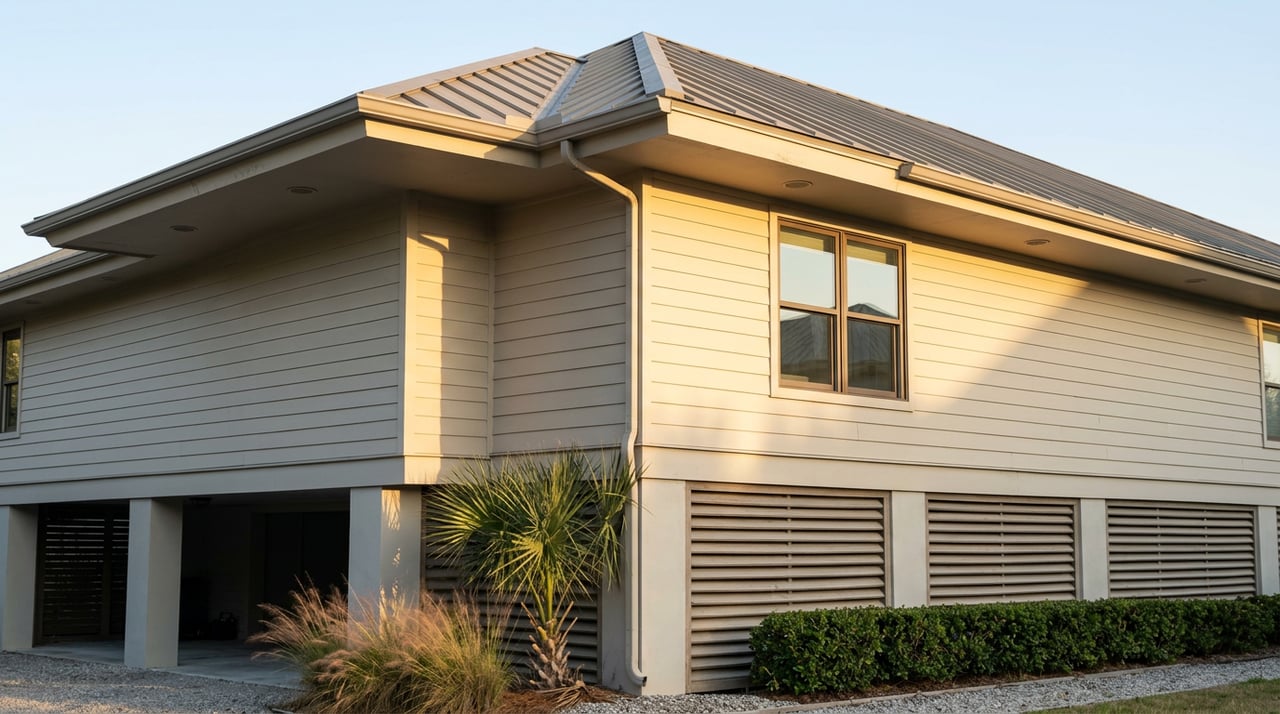
FORTIFIED is not a shingle brand or a marketing label. It's a construction standard developed by the Insurance Institute for Business and Home Safety, and it goes beyond what Alabama's building code requires. A roof built or retrofitted to the FORTIFIED Roof level has to withstand winds of 130 miles per hour, using a sealed roof deck, ring-shank nails driven deep into the plywood, and taped or membraned seams that keep water out even if shingles peel away. A certified evaluator inspects the work and submits documentation to IBHS before a home receives the designation.
The distinction matters because two roofs can look identical from the driveway and behave completely differently once the wind starts. One is engineered to keep water out after the shingles fail. The other isn't.
What Hurricane Sally proved about Gulf Shores roofs
This isn't theoretical for Gulf Shores. Hurricane Sally made landfall there as a strong Category 2 storm in September 2020. The University of Alabama's Center for Risk and Insurance Research, working with the Alabama Department of Insurance, later studied how homes performed during that storm and found that FORTIFIED-designated homes suffered significantly less damage and required fewer insurance claims than standard construction.
In the years since, local governments took notice. Fifteen zoning boards across Baldwin County, stretching from Bay Minette down to Gulf Shores and Orange Beach, now require new and reconstructed homes to meet the basic FORTIFIED standard, according to reporting from Scientific American. That's why a home built or substantially rebuilt in Gulf Shores over the past several years is far more likely to carry the certification than one from an older vintage that hasn't been through a major reroof.
The discount that's written into state law
The financial side of this isn't a carrier's marketing pitch. Alabama law requires insurance companies to discount the wind portion of a homeowner's premium when a home carries a FORTIFIED designation, with coastal properties eligible for savings of up to 35 percent, according to Smart Home America's program page. Separately, a University of Alabama study found that FORTIFIED homes sell for roughly 7 percent more than comparable homes without the designation, a figure cited in a Georgetown Climate Center report on the program's design.
Here's how that breaks down for a buyer comparing two similar homes:
| What changes with a FORTIFIED certificate | Effect |
|---|---|
| Wind portion of homeowners premium | Up to 35% lower on coastal properties |
| Resale value versus a comparable non-certified home | Roughly 7% higher, per University of Alabama research |
| How long the designation lasts | 5 years, then a re-evaluation is required |
None of that shows up on a standard listing sheet. It shows up on the insurance declaration page, which is exactly why the two buyers touring that Gulf Shores block last Saturday didn't see it coming until the quotes landed in their inbox.
The five-year clock nobody mentions at closing
The certification isn't permanent. It expires five years after issue, and keeping the discount active requires a re-evaluation inspection, not a full reroof, just a check that the original work still meets the standard. That creates a timing problem buyers rarely think to ask about.
A home certified in year one of its cycle is a very different asset than a home certified in year four. The first has years of discounted premiums ahead of it. The second is approaching a point where, if nobody schedules the re-evaluation, the discount can quietly disappear at the next policy renewal, sometimes without the new owner realizing why their premium jumped.
Asking a seller whether a roof is "new" isn't the same question as asking whether it's FORTIFIED and when the certificate was issued. Those are two different facts, and only one of them predicts next year's insurance bill.
The grant window that can close in minutes
Retrofitting an existing roof to meet the standard typically costs between $700 and $2,000, while building a new roof to the FORTIFIED specification runs $10,000 to $15,000, per the same Scientific American reporting on the program's costs. For homeowners who want to certify an older Gulf Shores roof without absorbing that cost themselves, Alabama's Strengthen Alabama Homes program covers up to $10,000 of the mitigation work, with no income requirements.
The catch is timing. The grant is funded on a first-come, first-served basis, and Baldwin County's next application window opens October 8, 2026 at 9:00 a.m. According to the program's own site, the portal "closes the moment all grants are gone," and being even a few minutes late can mean waiting another quarter. Lars Powell, the University of Alabama researcher who has studied the program, described the demand bluntly: "we have a backlog of applicants that we're turning away."
That's not a bureaucratic footnote. It's a real constraint on how quickly an uncertified Gulf Shores home can close the gap with a certified one, and it's worth knowing about whether you're the buyer weighing a fixer-upper or the seller deciding whether to certify before listing.
What to check before you write an offer
A few questions turn this from an abstract insurance quirk into something you can actually verify during a showing or before you submit an offer:
- Ask for the FORTIFIED designation certificate itself, not just a verbal description of "hurricane-rated" work. The certificate shows the issue date and the level of certification.
- If the certificate exists, check how far into its five-year cycle the home is. A certificate issued four years ago carries less remaining discount runway than one issued last year.
- If there's no certificate at all, ask your insurance agent for a same-carrier quote comparison so you're pricing the actual home in front of you, not a citywide average.
- If you're the one considering a retrofit before selling, factor the SAH grant's quarterly application window into your timeline. Missing it by a day means waiting for the next cycle.
What this means at today's price point
Two homes at the same list price in Gulf Shores are not the same purchase once you account for total carrying cost. Insurance is often the largest recurring expense after principal and interest on a coastal Alabama mortgage, and the presence, age, and status of a FORTIFIED certificate can shift that bill by thousands of dollars a year. Over the life of a mortgage, that's not a rounding error. It's the kind of detail that belongs in the same conversation as price per square foot, not an afterthought after the inspection period has already started.
Frequently Asked Questions
Does every home in Gulf Shores have to meet the FORTIFIED standard? No. The requirement applies to new construction and substantial reconstruction under local zoning ordinances. Older existing homes aren't required to retrofit, though they become eligible for the insurance discount and resale premium once they're certified.
Is FORTIFIED the same thing as meeting current building code? No. It's a voluntary standard that sits above Alabama's baseline building code, developed and certified independently by IBHS.
Does the insurance discount apply automatically once a roof is certified? No. The homeowner has to take the designation certificate to their insurance agent and have it applied to the policy. It doesn't happen on its own.
If a seller says the roof was recently replaced, does that mean it's FORTIFIED? Not necessarily. A new roof only carries the designation if it was built to the sealed-deck specification and inspected by a certified evaluator who submitted documentation to IBHS. A standard reroof, even a brand new one, doesn't automatically qualify.
If you're comparing homes in Gulf Shores and want help reading past the list price to the real cost of ownership, David Coate and the Coate Connection team can walk through a property's certification status, insurance picture, and negotiating position before you write an offer. Schedule a free consultation to get started.